Areas of Expertise Up Close: Manufacturing Technology
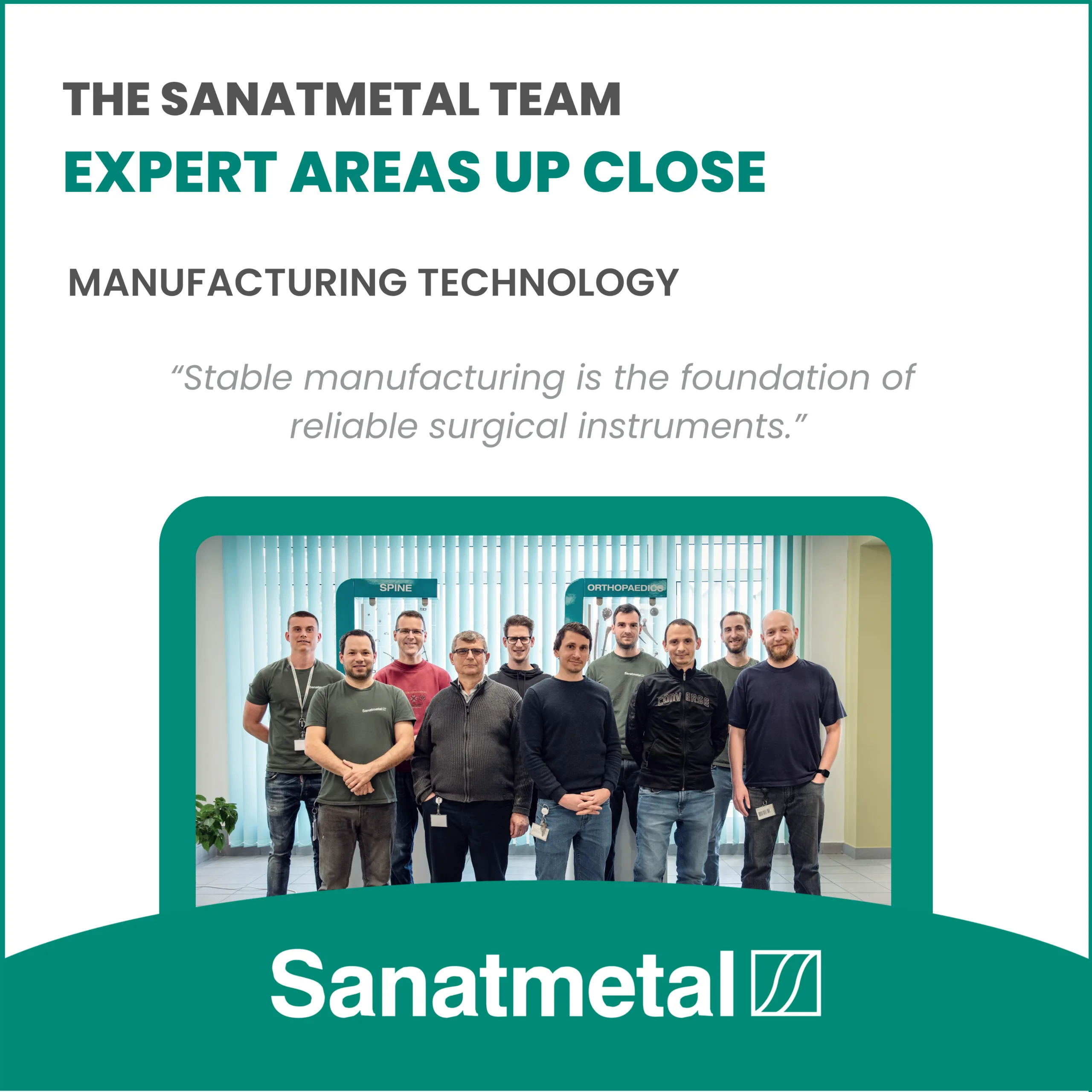
Stable operations, competitive solutions and continuous professional support – the work of manufacturing technology often takes place in the background, yet it fundamentally determines the efficiency and safety of everyday operations. This is the area that ensures that the production of implants and surgical instruments is not only feasible, but also predictable, high-quality and sustainable in the long term.
The role of the manufacturing technology team goes far beyond ensuring that a product can be “manufactured”. The focus is on stable, repeatable and controlled manufacturing processes, the consistent fulfilment of quality expectations, and ensuring that production receives the appropriate professional support in every situation. The work of the department is closely connected to manufacturing, technical preparation, documentation, technical problem-solving and continuous improvement.
All of this directly serves the goal of enabling surgeons working in the operating room to use instruments that provide predictable quality, reliability and consistent performance, day after day.
Varga Norbert, Head of Manufacturing Technology, shared his experiences on how the operation of the department has changed in the new setup, what tasks and responsibilities guide the team’s work, what challenges characterise everyday operations, and where the results of manufacturing technology can be seen most clearly.
Multiple areas, coordinated operations
The manufacturing technology organisation currently carries out its tasks with a team of 10 people, including the manager, and supports the production of orthopaedic implants and surgical instruments. The team’s work covers six main areas: instrument manufacturing, orthopaedic implants, screw implants, plate implants, intramedullary nail production, and finishing operations – including surface treatment and sterile packaging.
Operations take place at several locations, which means that conscious task allocation and coordinated presence form the basis of daily work. A significant change has been that manufacturing technology has now become a more organised and more unified department. As a result of this transformation, operations have become more transparent, prioritisation has become faster, and responsibilities have become clearer. Each main area has its own technology owner, enabling more targeted and focused professional support. In addition, increasing emphasis is being placed on interoperability between the different technology areas, further strengthening the team’s flexibility.
Why is this work particularly complex?
Manufacturing technology is a highly diverse professional field. It brings together a wide range of competencies, from documentation tasks through production preparation, CAD/CAM-related technical work and programming tasks, all the way to development and optimisation activities. The team provides day-to-day production support while also working on longer-term development goals.
The greatest challenge is maintaining a balance between technical tasks that require a quick response and the planned, in-depth work needed for manufacturing development. In the initial period of the new organisational setup, particular attention had to be paid to clarifying roles, priorities and points of cooperation; today, the central task is to keep these operating in a stable way. Due to prototype production, changing requirements and the combination of different technologies, no two working days are exactly the same.
Creating value in the background as well
A significant part of the work of manufacturing technology is less visible from the outside, yet it is decisive for the entire manufacturing process. This includes, among other things, preparing and managing product changes, designing and producing CNC toolpaths and manufacturing tools, as well as identifying and solving problems that arise during production. All these processes contribute to ensuring that manufacturing operates in a stable and predictable way in the long term.
The team works with a wide range of machines and technologies: supporting CNC Swiss-type lathes, CNC milling machines, special-purpose machines and special operations all belong to the department’s scope, while 3D printing is also an integral part of everyday work. This broad technological spectrum requires continuous learning, adaptation and development. Today, the efficiency of daily work is also supported by digital tools and artificial intelligence-based solutions.
What they are especially proud of
For manufacturing technology, success is best measured by stable production, problems being solved in a timely and well-founded way, and developments improving manufacturability and everyday operations in the long term. It is of particular value that the team is able to provide coordinated professional support across several locations and in different technological areas.
Manufacturing technology is present both in daily operations and in development. As a result, it plays a genuine connecting role between production, technical preparation, quality and development – with the aim of ensuring long-term sustainable, safe and competitive manufacturing.